Security Grade
One grade for the whole estate: see where you stand today, prove where you were last quarter, and show the trend line moving the right way.
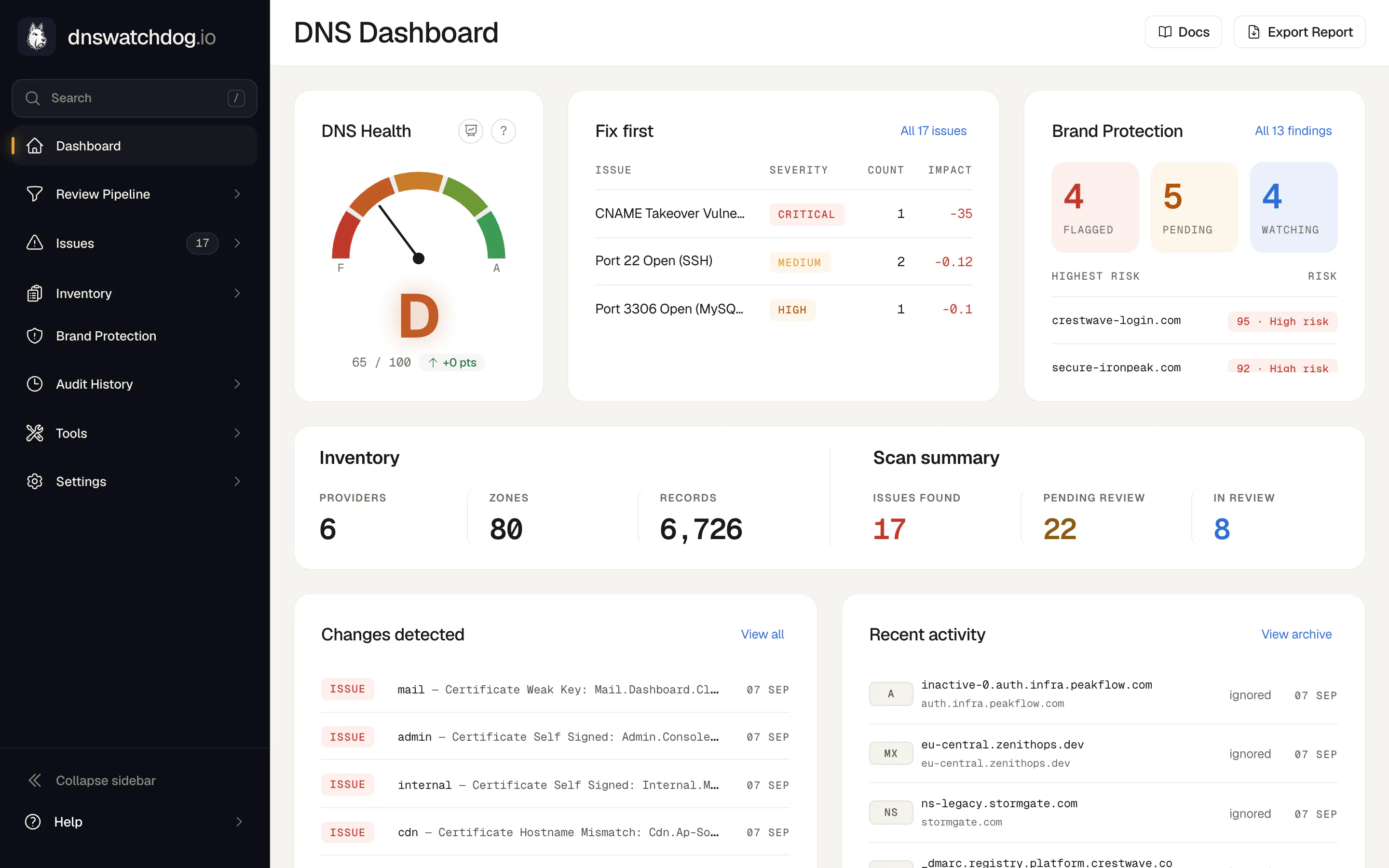
Security posture is hard to communicate. The engineers see a list of issues; the board wants a number; the auditor wants evidence of change over time. DNS Watchdog condenses your entire DNS security position into a letter grade from A to F backed by a 0-100 score: honest enough to drive engineering priorities, simple enough to put on one slide.
The scoring is mechanical. You start at 100 and every open finding deducts points: a severity-weighted amount spread across the size of your estate, measuring issue density rather than raw count, so a large, largely-healthy estate is not punished for its size and small estates are never zeroed by a single finding. Critical findings play by harsher rules: each one deducts a flat 35 points that no amount of estate size can dilute, so a single Critical caps your score at 65 (a D at best, whether you run ten records or a hundred thousand) and more than one means an F. The deductions simply add up, and a step-by-step breakdown in the app itemises every point.
Because every scan snapshots the score, the grade comes with a history: the movement since the last scan, and the trend across weeks and quarters. The top issue types are ranked by how many points each is costing you, so 'what should we fix first?' has a quantified answer, and the score history shows the effect of every fix: a record you can put in front of the board, an auditor, or a customer's security questionnaire.
How it works
- ScanDaily scans across your whole estate produce the current set of open findings, the raw material of the grade.
- WeightEach open issue contributes to the score according to its severity. A Critical takeover risk weighs an order of magnitude more than a low-impact observation.
- Scale by estate sizeEach finding's weighted points are spread across the size of your estate, measuring issue density rather than raw count.
- Add the critical surchargeCritical findings deduct a flat 35 points each, whatever your estate size: one open Critical means at best a 65 (a D), and two or more mean an F. Estate size never dilutes a takeover risk.
- Grade and trendThe 0-100 score maps to a letter band (A at 90 and above, down to F below 60) and every scan appends an immutable snapshot to your score history.
What you get
- Estate-wide grade computed from live scan findings
- A-F letter grade backed by a 0-100 score of itemised deductions that add up exactly
- One open Critical caps the score at 65 (a D at best) and two mean an F, at any estate size
- Top issue types ranked by score impact, so you fix what moves the needle
- Immutable score history, snapshotted every scan, with since-last-scan movement
- Drill down from the grade to the exact issues driving it
Why it matters
A shared language for posture
Engineers, executives, and auditors can all read a B trending toward an A. The grade turns a specialist issue list into a conversation anyone can join.
Priorities backed by numbers
Score-impact ranking answers the question of what to fix first with the issue types actually dragging the grade down, rather than the ones that merely feel urgent.
Progress you can prove
The score history is a record of your programme working: where you were last quarter, what each remediation push achieved, and the trend line to show for it.
Faster security reviews
Customer questionnaires and compliance reviews ask how DNS security is managed and measured. A continuously computed grade with drill-down evidence is a better answer than a paragraph of prose.
FAQ
How is the grade actually calculated?
Your score starts at 100 and every open issue deducts points: its severity weight spread across the size of your estate (small estates are scored against a 50-record minimum, so one finding is never catastrophic), plus a flat 35-point deduction for each Critical finding that estate size cannot dilute, so one Critical means at best a 65, a D, at any estate size. The deductions simply add up; the app's step-by-step breakdown itemises every point, and they sum to exactly your score. The score maps to letter bands (A at 90+, B at 80+, C at 70+, D at 60+, F below), so the number is never a black box.
How do I improve my grade fastest?
Clear any Critical findings first, since each one deducts a flat 35 points regardless of everything else you fix. After that, the Top Issue Types view ranks issue types by how many points each is costing you, so you can target the classes of finding that actually move the number.
Can I use the grade with auditors and customers?
That is one of its main jobs. The grade demonstrates continuous monitoring and the history demonstrates management over time. Each snapshot records the scoring scheme it was computed under, so historical grades stay meaningful, and the drill-down provides the evidence trail for SOC 2-style reviews and security questionnaires.